Menu from Jammet’s, 1937

Jammet's menu

Jammet’s was the only French restaurant in Dublin for many years 

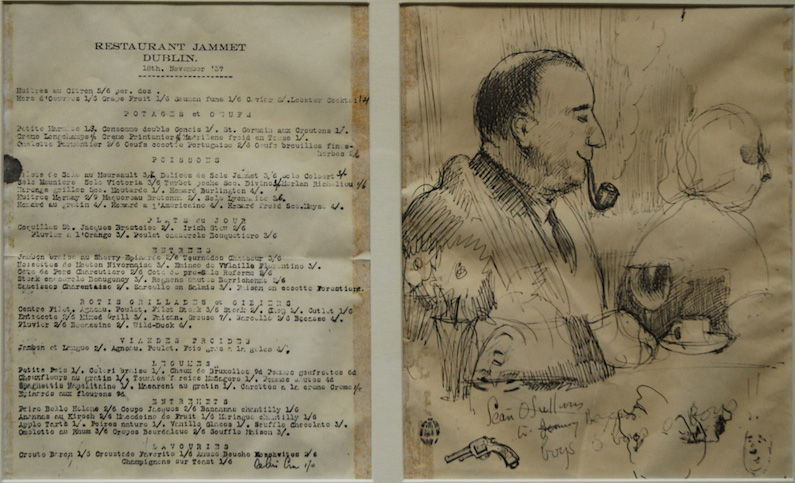
The place where all of Dublin wanted to eat, and few could afford, Jammet’s opened in 1901 on Andrew’s Street, but moved to Nassau Street in 1927, where it continued to dazzle until 1967.

In “Dublin’s only French restaurant” – a claim sustained for 40 years – W.B. Yeats had his own table, Hilton Edwards and Micheál MacLiammóir were regulars, and visitors ranged from Laurel and Hardy to Walt Disney and Ronald Reagan. The drawing is by the artist Seán Ó Sullivan.

With thanks to Michael Maughan

Watch footage of Dublin in the 1930’s and 1940’s:
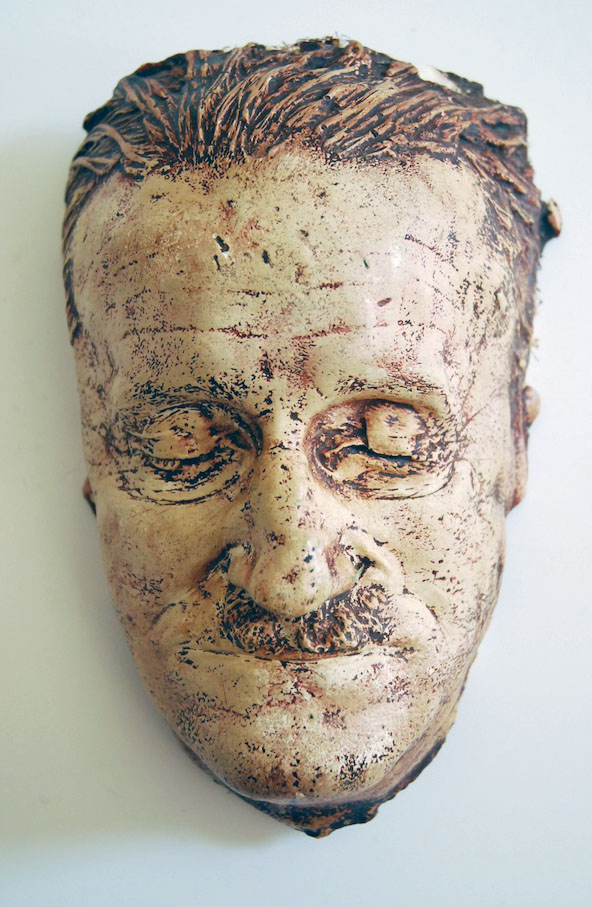
James Joyce’s Death Mask, 1941

James Joyce death mask

A facsimile of Joyce’s death mask, made after he died in Zurich in 1941

On 11 January, 1941, James Joyce – who was 58 years old – underwent surgery for a perforated ulcer in a Zurich hospital. The following day he fell into a coma, before waking, briefly, and calling for his wife and children. They were still on their way to the hospital when he died 15 minutes later.

While two senior Irish diplomats were apparently in Switzerland at the time, neither attended Joyce’s funeral, and the Irish government subsequently declined Nora Joyce’s offer to permit the repatriation of his remains. This facsimile of Joyce’s death mask commemorates our greatest novelist.

Permanent Collection

Listen to a reading from Ulysses by James Joyce:

Souvenir of the Irish International Exhibition, 1907

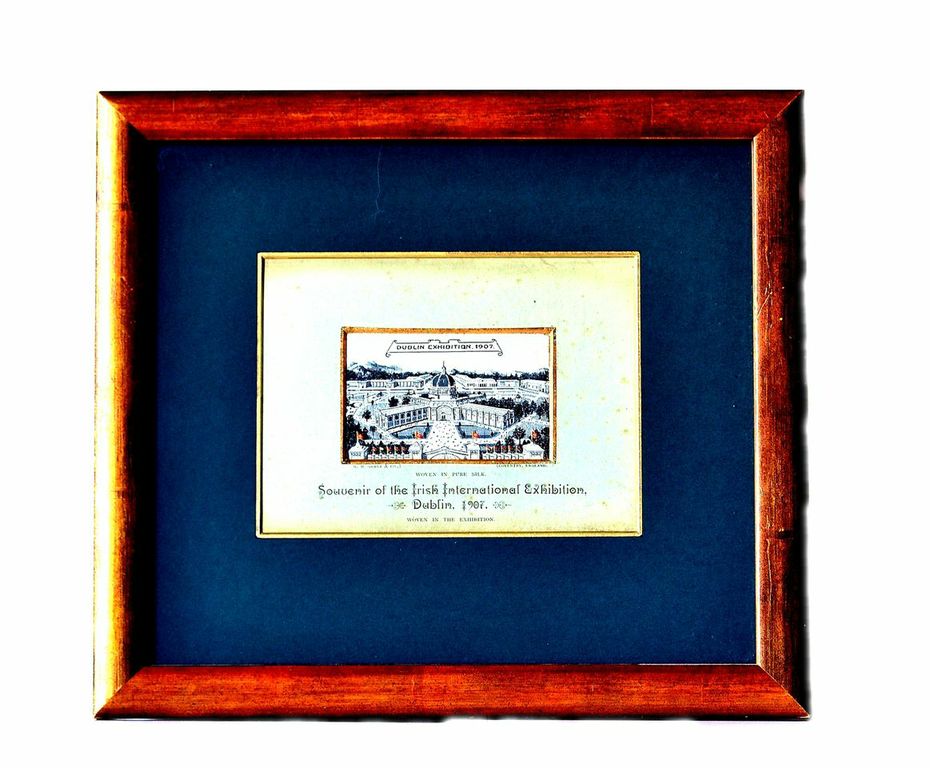
Souvenir of the Irish International Exhibition, 1907The Irish International Exhibition was held in Herbert Park in 1907

The Irish International Exhibition was the key social event of the first decade. It was hosted on the grounds of Herbert Park in Ballsbridge between May and November of 1907. The aim was to promote domestic industry by showcasing Irish products, as well as encouraging the development of commercial links by inviting all countries to exhibit their goods.

Nearly three million visitors came to ogle at everything from industrial machinery to fine art, but the main attraction was a full-scale Somali village and the rare whimsy of a water chute and switchback railway.

Permanent Collection

Listen to a reading of the opening address by the Lord Lieutenant and Earl of Aberdeen, John Campbell:

Ireland v Hungary, 1939

Ireland v Hungary

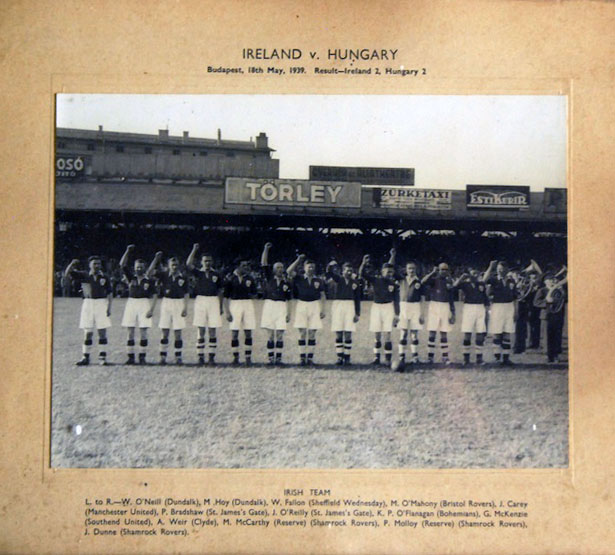
The Irish soccer team, who took on Hungary in 1939

At first glance it looks as if the Irish soccer team is giving a fascist salute in this picture, which was taken in Budapest. In 1939, Hungary was ruled by a right-wing dictator, and was close to Germany and Italy. But Hungary was not fascist, and while it did have a fascist movement, it was a threat to the ruling regime, and was actually banned in 1939. Some members of that movement, the Arrow Cross, did use a closed-fist salute (the classic fascist salute was open-handed) but the truth is probably more innocuous. Three cheers for Hungary?

With thanks to the FAI

Collection of Dublin Hotel Tea Cups, 1970s

Hotel teacups

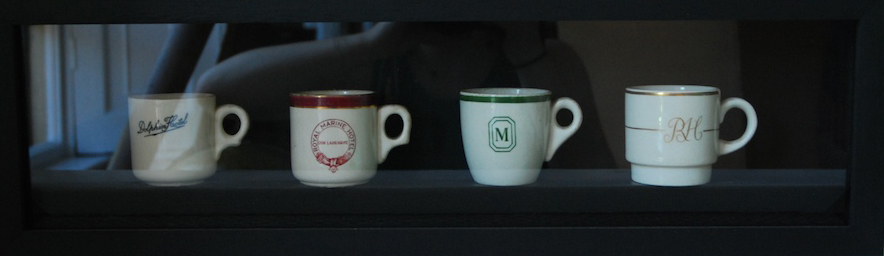
Teacups from hotels in Dublin

1. Dolphin Hotel. This fine Gothic building is on East Essex Street. It was later converted into Dublin District Court offices.

2. Royal Marine Hotel. Originally the Hayes Royal Hotel (1828), the hotel was bought in 1863 by William Dargan, builder of the Kingstown Railway, and was rebuilt and reopened as the Royal Marine Hotel in 1865.

3. The Metropole Hotel. During the 1916 Rising this hotel, adjacent to the GPO, was completely destroyed. The same site is now home to Penney’s clothing store.

4. Royal Hibernian Hotel. Formerly located on Dawson Street, this grand old hotel was demolished in the 1980s to make way for the Royal Hibernian Way.

Permanent Collection

Watch some footage of 1970’s Dublin:

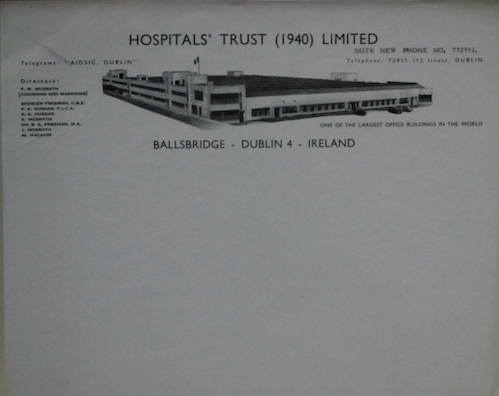
Hospitals’ Trust Letter Head, 1947

Hospitals' trust

Letter head of the infamous Irish Hospital’s Sweepstake

The Irish Hospitals’ Sweepstake was established by the Free State government in 1930 as a way to finance the country’s health care system. Many tickets were sold illegally in Britain and the US.

In 1940 the Sweepstake moved to a permanent home in newly-built Ballsbridge offices, designed by John Joseph Robinson. The building was seen as the most striking example of Robinson’s modernist art-deco designs. The final Sweepstake was held in January 1986.

Permanent Collection

Watch a video showing New York winners of the Sweepstakes:

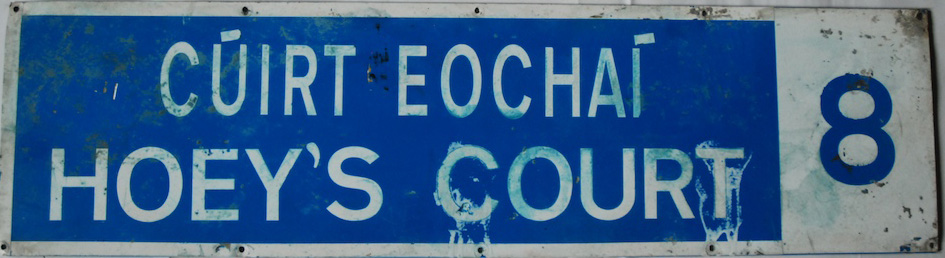
Hoey’s Court Street Sign, 1970s

Hoey's court

Jonathan Swift’s birthplace

Hoey’s Court would mean nothing to the world, or indeed to Dubliners, except that Jonathan Swift, a famous satirist and poet, was born here in 1667.

Permanent Collection

Listen to a reading of ‘A Modest Proposal’, written by Jonathan Swift:

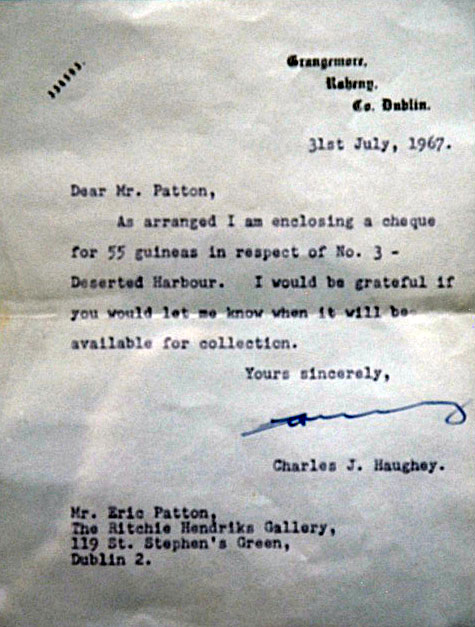
Letter from Charles Haughey, 1967

Haughey letter


A letter from the then Minister for Finance and later Taoisech of Ireland, Charles J. Haughey, to Eric Patton

Charles Haughey was Minister for Finance at the time he wrote this letter to Eric Patton, from the Richie Hendriks Gallery. While the gallery, which was here on Stephen’s Green, was cutting-edge, the painting in question recently sold for just €800. In the same year, Haughey sold his old house in Raheny for £200,000, having bought it for £50,000 ten years earlier. The land had been rezoned in the interim.

Opening an office building on St Stephen’s Green that year, he announced, “I, for one, have never believed that all architectural taste and building excellence ceased automatically with the passing of the 18th Century.” That same year, 1967, Haughey bought Abbeville, an eighteenth century mansion designed by Gandon.

Permanent Collection

‘Showdown on Wood Quay’, 1978

Hibernia wood quays

The remains of a viking settlement were discovered on Wood Quay

A site on Wood Quay was acquired by Dublin Corporation for their HQ in the 1970s. Excavations turned up a major viking settlement, but a vocal campaign to stop the construction of the new headquarters was unsuccessful. It was one of the key local battles of the decade.

Permanent Collection

Watch footage of the protests of Wood Quay:

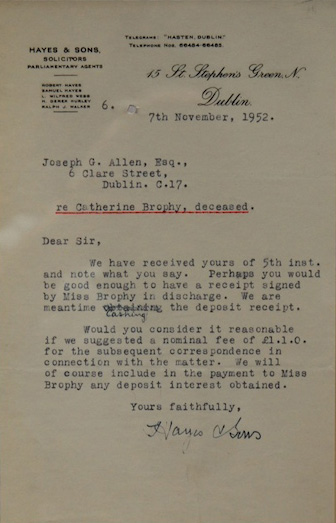
Letter from Hayes and Sons Solicitors, 1952

Hayes solicitors

Hayes and Sons occupied the building which now houses the Little Museum

Note the address. This politely worded invoice is from Hayes and Sons, former occupants of 15 St Stephen’s Green. It was a prominent law firm, with five partners in 1952 when the letter was written. Louis Wilfred Webb, one of the partners who worked in this room, owned Ballawley estate, part of the land on which the Dundrum Shopping Centre is now built.

Permanent Collection