Think Big, by Caroline McCarthy, 1990s

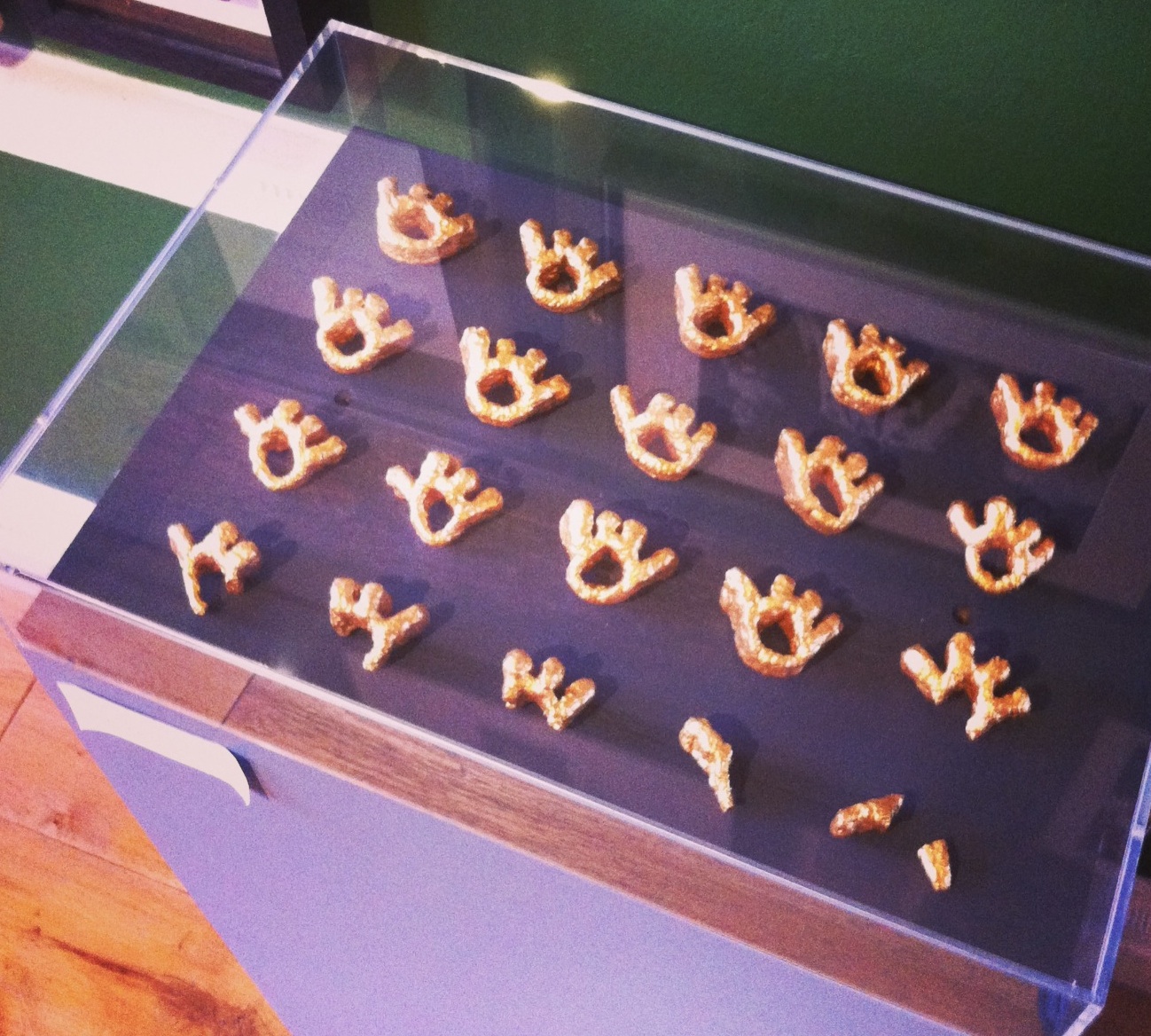
Crisps

Ten of Ireland’s most accomplished artists have each produced a piece that reflects on some aspect of life in Dublin during the 20th Century

The final decade, the 1990s, was the beginning of the Celtic Tiger, and a decade also fuelled by the feel-good factors of Italia 90, the Presidency of Mary Robinson and the ceasefire in the North. An exciting contemporary artist working in a wide range of media, Caroline McCarthy’s practice often incorporates found and banal objects given an ironic, witty or hilarious twist with a quick change of context.

Caroline McCarthy is riffing on the bling, consumerism and disposability of the 90s by incorporating a packet of Monster Munch into her piece, which is called Think Big. Designed specifically as a museum exhibit, but sending up the very nature of significance and historical value, Think Big is an inventive commentary on that overblown decade.

With thanks to Caroline McCarthy

Watch a documentary about the collapse of the Celtic Tiger:

Irish Telephone Directory , 1962

Telephone directory 1962

Telephones only became widespread in Ireland in the second half of the twentieth century

This small telephone directory covers the whole of the Republic of Ireland – and less than half the book is devoted to phone numbers outside of Dublin.

The first pages contain instructions on using a phone, with advice like ‘replace receiver before re-dialling,’ and ‘speak directly into the transmitter.’ There was no standard emergency number in those days – it is 999, 9999, 10 or 0, depending on the user’s location.

Permanent Collection

The Tailteann Games by P. J. Lynch, 1920s

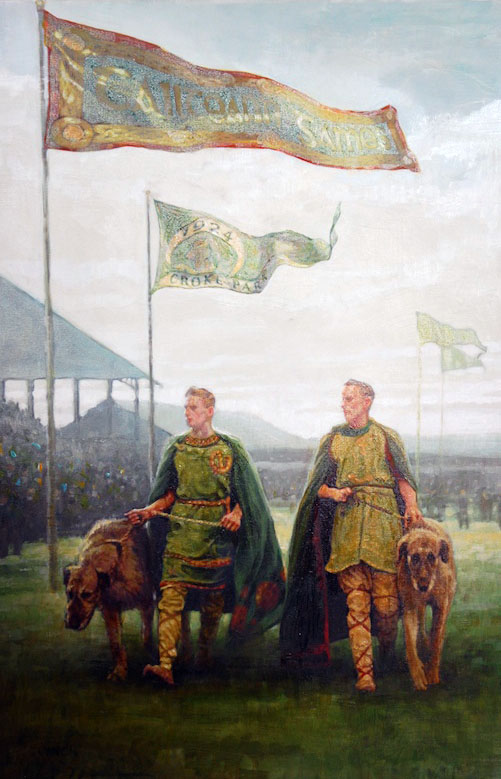
Taillteann Games

Depiction of the celebrations during the opening ceremony of the Tailteann Games

Ten of Ireland’s most accomplished artists have each produced a piece that reflects on some aspect of life in Dublin during the 20th Century

The celebrated illustrator P.J. Lynch took on the decade of the twenties, a period of civil war and economic hardship which was illuminated by the Tailteann Games.

These games were one of the attempts by the new government to foster a Celtic spirit in a newly free nation. Ancient imagery informed the event’s style and approach, which included sporting and artistic events across the city. Returning athletes from European-based Olympic games participated, raising the profile of the Tailteann Games which continued throughout the decade. Johnny Weismuller, Tarzan from the movies and an Olympic swimmer, participated in a swim in the Phoenix Park. P.J. depicts the opening ceremony in Croke Park.

With thanks to P. J. Lynch

Watch footage of scenes in Ireland in 1920:

Switzer’s Box, 1950s

Switzers box

Switzer’s was a well known department store on Grafton Street

Grafton Street was anchored by Switzer’s and Brown Thomas department stores. Switzer’s was the less elite of the two – many customers never crossed the street to shop in Brown Thomas. The basement café was an old-fashioned parlour with waitresses in black dresses and white aprons. Switzer’s was bought by Brown Thomas in 1995; BTs moved into the Switzer’s building across the street. You can still see the Switzer’s logo on the Wicklow Street side of Brown Thomas.

Permanent Collection

Watch footage of Ireland in the 1950’s:

Sunday Independent, 1972

Sunday Independent

An issue of the Sunday independent, including a profile of Tony O’Reilly

The Irish Independent was launched in 1905, successor to the Daily Irish Independent. The paper was owned by William Martin Murphy, and stayed in his family until it was purchased by Tony O’Reilly in a protracted coup between February 1972 and March 1973.

This issue from July 1972 features a short, sycophantic profile of the new boss – no more, really, than a snapshot of his rapid rise. O’Reilly made his first million that year, and the Independent would soon become the cornerstone of his media empire.

Permanent Collection

Watch a speech by Sir Anthony O’Reilly in 2007:

First Issue of Sunday Business Post, 1989

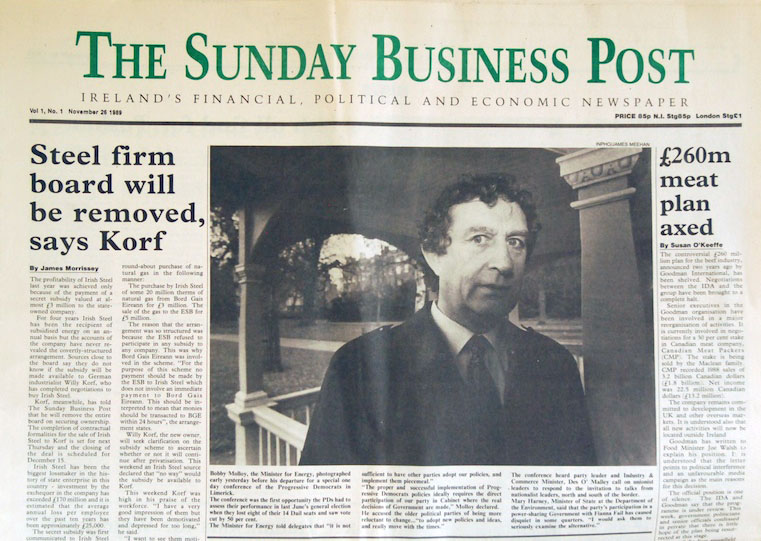
Sunday Business Post

Ireland’s financial, political and economic newspaper

This is the first edition of the Sunday Business Post, dated November 26th 1989. Edited by Damien Kiberd, the paper would benefit from much-increased levels of advertising as Ireland’s economic fortunes improved in the 1990’s.

With thanks to Winter Hynes

Watch examples of Irish advertisements in the 1980’s:

St. Columba’s Appeal, 1910

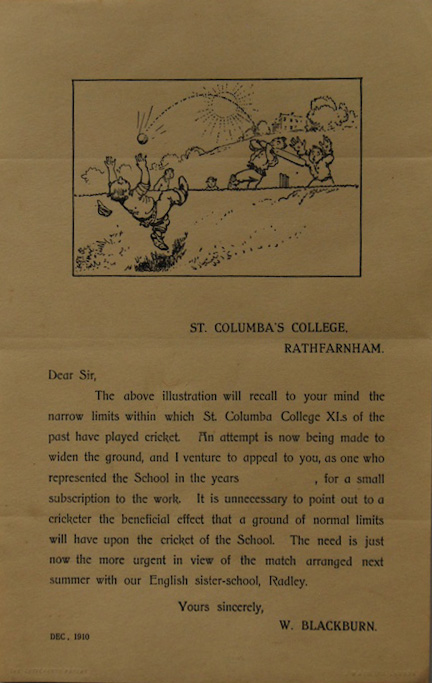
St Columba's college

St. Columba’s College appeal to widen the cricket pitch

Just up the road from Patrick Pearse’s school, Scoil Éanna, there was a Protestant boarding school, St. Columba’s College, where the aim was to furnish the sons of the landed gentry with a decent education. Here the college appeals to old boys for a few quid to widen the cricket pitch, a need that is all the greater in view of the upcoming game against sister school Radley.

With thanks to St. Columba’s College

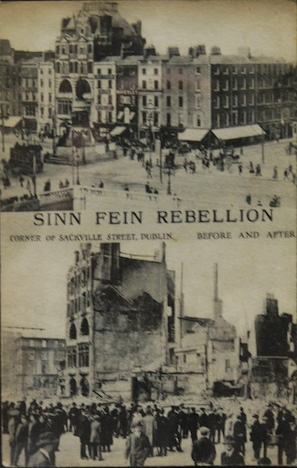
Sinn Féin Rebellion, 1916

Sinn Fein rebellion

Sackville Street in the aftermath of the Easter Rising

This picture shows Sackville Street (now O’Connell Street) before and after the 1916 Rising. Like many documents of the period, it refers to the Rising as the Sinn Féin Rebellion. Sinn Féin had nothing to do with the Rising, though nationalists flooded into the party as public opinion turned against British rule.

Permanent Collection

Watch a documentary on the rise of Sinn Fein:

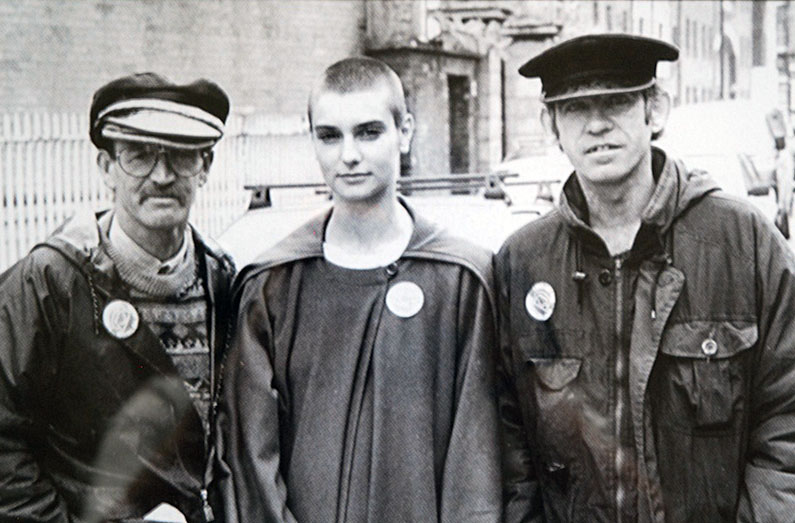
Sinéad O’Connor by Bill Doyle, 1995

Sinead O'Connor

Lock-hards were a fixture of Dublin life for decades. They would shout unsolicited parking advice, hoping for a fee. Peaked caps lent them a spurious air of authority

Sinéad O’Connor is an Irish singer who won fame with her cover of Prince’s ‘Nothing Compares 2 U’. She has often been a figure of controversy, expressing strong views on organised religion and women’s rights, most famously tearing up a picture of Pope John Paul II on US television. A Dubliner is someone who loves to remind you that Sinead O’Connor once worked as a waitress in the Bad Ass Café.

With thanks to Leslie Doyle for Bill Doyle and Lilliput Press.

Watch an RTÉ profile on Sinead O’Connor:

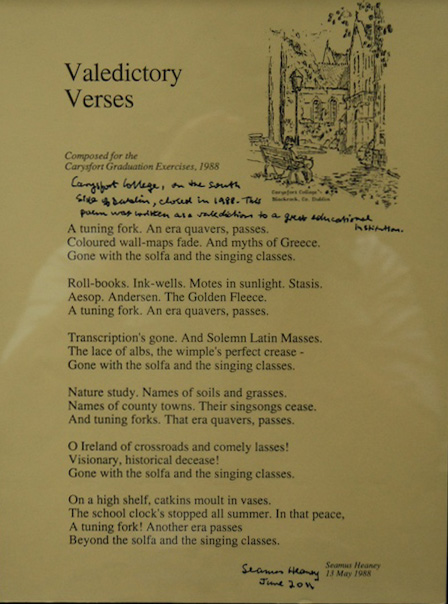
Valedictory Verses by Séamus Heaney, 1988

Seamus Heaney Valedictory Verses

Poem written to mark the closing of Carysfort College in Blackrock

Séamus Heaney wrote this poem to mark “a significant moment in the history of Dublin” – the closure of Carysfort College in Blackrock. The Nobel-prize winning poet taught at the teacher-training college between 1975 and 1981, before he took up a position at Harvard.

Carysfort was founded in 1877 as a college for Catholic girls who wished to become teachers. Other lecturers at the college included Éamon de Valera and Eoin MacNeill, co-founder of the Gaelic League and founder of the Irish Volunteers. The poem was written, as Heaney notes, “to mark the end of an era.”

With thanks to Seamus Heaney