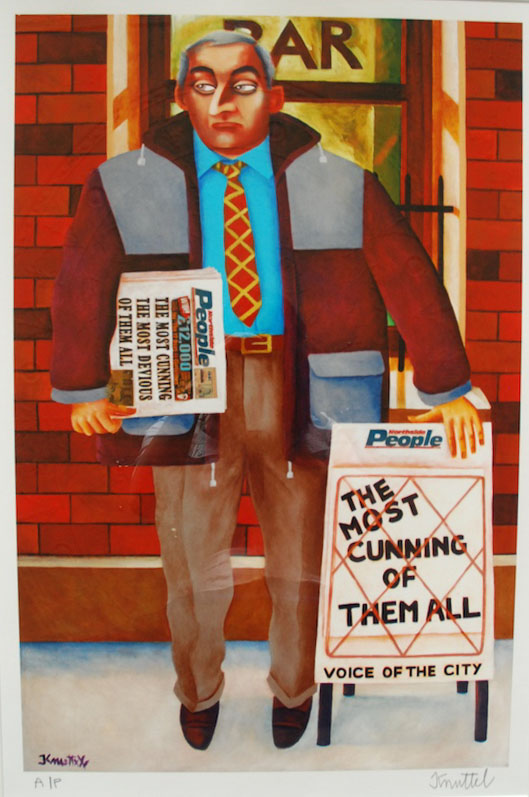
Bertie Ahern by Graham Knuttel, 1990s

Graham Knuttel Bertie Ahern

Graham Knuttel painted gently satirical pictures of all the Taoisigh

This painting references Ahern’s reputation as a man of the people – his famous anorak, that pub in Drumcondra opposite his constituency office. Charlie Haughey’s much quoted description – “The Most Cunning of Them All” – refers to the other side of Ahern’s reputation.

Permanent Collection

Watch a video about the Mahon Tribunal and Bertie Ahern:
Charles Cushman’s Dublin – Grafton Street, 1961

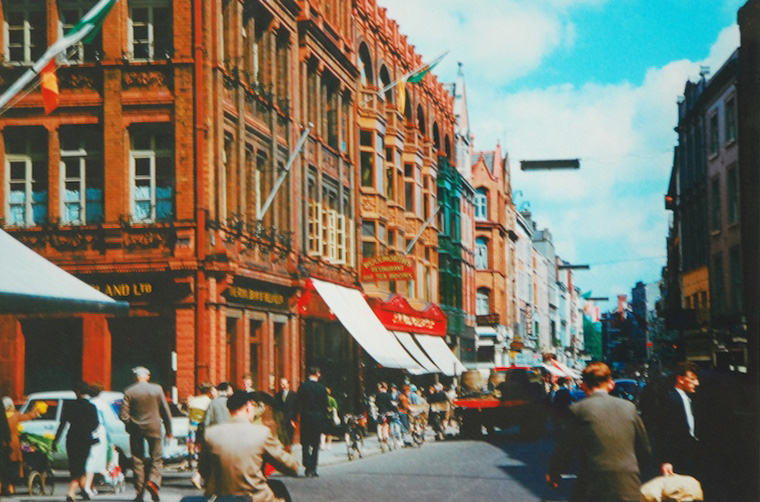
Grafton Street 1960s

Charles Cushman was an enthusiastic amateur photographer

Cushman made a visit to Dublin in 1961. On his death he bequeathed 14,500 photos to his alma mater, the University of Indiana.

Grafton Street was named after Henry FitzRoy, 1st Duke of Grafton, the illegitimate son of Charles II. The street was developed from a country lane by the Dawson family in 1708. Today it feels like a bland British high street.

Copyright and reproduction rights for all Charles W. Cushman photographs are held by Indiana University and administered by the University Archives, Indiana University, Bloomington, IN 47405

Ration Book, 1948

General ration book

Despite the Free State’s neutrality, the country suffered some rationing during the war years

During the ‘Emergency’ the Free State had a rationing system like that in Great Britain. Sugar, tea, butter, margarine, bread, flour and clothing were among the many items for which ration tickets were required. Poor families were hardest hit by the restrictions as bread was a central part of their diet.

The most unpopular figure at the time was not Minister for Supplies Seán ‘half-ounce’ Lemass, but the notorious ‘glimmer man’ who went door-to-door to ensure that citizens were not using gas after hours.

Permanent Collection

Watch a video of the Declaration of the Republic, just one year later:

Postcard from George Bernard Shaw, 1943

In 1943, George Bernard Shaw was asked to predict when the Second World War would end.

In 1943, George Bernard Shaw was asked to predict when the Second World War would end.

In 1943 the playwright George Bernard Shaw was living in London. Shaw went to school here on St. Stephen’s Green, and never lost his accent, even though he left Dublin at 20.

A magazine called The Strand asked a number of writers when they thought the Second World War would end. “Nothing doing,” Shaw writes here, “I never prophesy until I know; and nobody yet knows where those two will end. My best guess is that Adolf will enjoy a dignified retirement in the ViceRegal Lodge in Dublin, which is presumably to let at present.”

Permanent Collection

Watch a documentary about Nazis in Ireland after World War II:

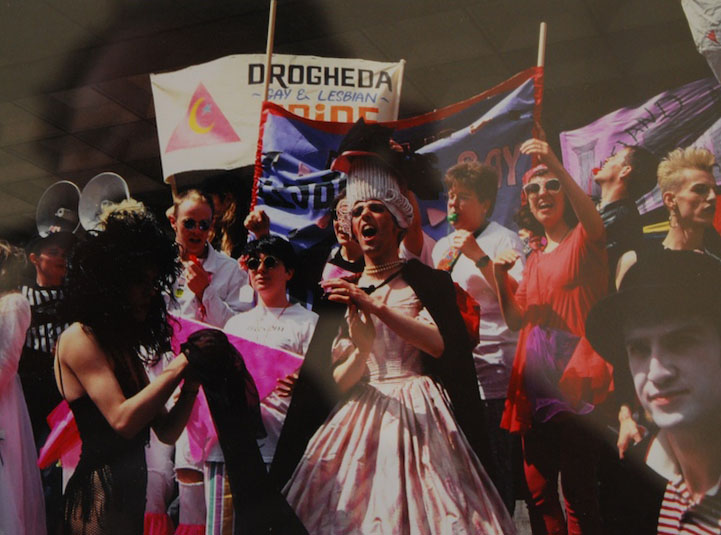
Pride Parade, 1993

Gay pride

Homosexuality was illegal in Ireland until 1993

The 1993 Pride Parade was held the day after the old criminal laws were abolished, and the celebrations on the steps of the Central Bank were, in the words of photographer Christopher Robson, “wild and memorable.”

With thanks to Christopher Robson

Visit the RTE Archives to listen to the announcement of the decriminalisation of homosexuality:

http://www.rte.ie/archives/2013/0621/457935-20-years-since-decriminalisation-of-homosexuality/#.UcbJ1Zj-4G1.gmail


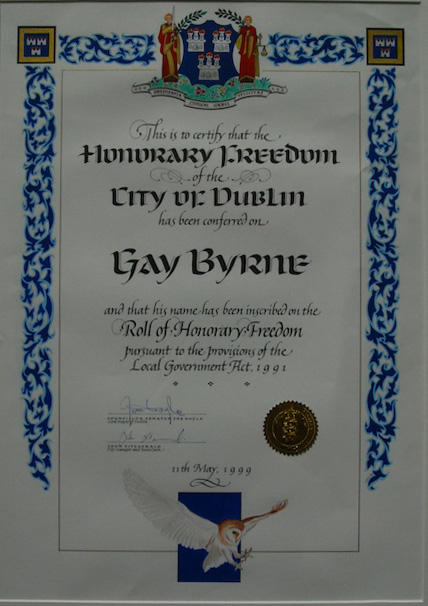
Gay Byrne’s Freedom of the City, 1999

Gay Byrne Freedom of the city

Gay Byrne is one of the most well-known television personalities in Ireland

Gay Byrne hosted RTÉ’s flagship talk show, the Late Late Show, for 37 years from its first broadcast in 1962. Byrne was a major catalyst in the transformation of Irish society, riffing on abortion, contraception and homosexuality.

The Late Late Show featured an owl on its opening credits, hence the owl’s appearance on Byrne’s freedom of the city award. Byrne retired in 1999, but still pops up on Irish television.

With thanks to Gay Byrne

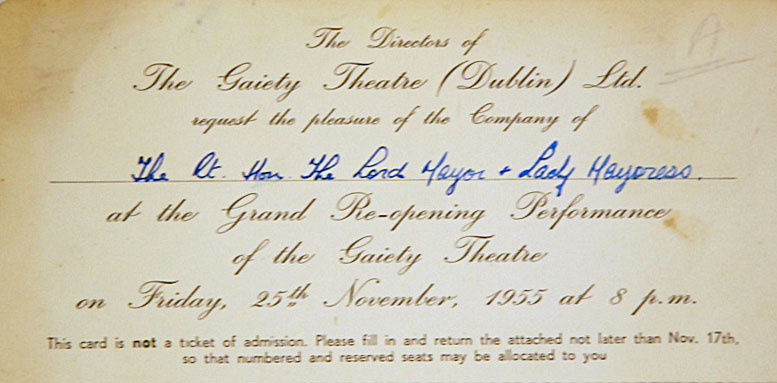
Re-Opening of the Gaiety Theatre, 1955

Gaiety theatre invitation

An invitation to the Lord Mayor of Dublin to attend the performance that re-opened the Gaiety on the 25th of November, 1955

The Gaiety had been forced to close ten months previously when Dublin Corporation condemned the upper circle balcony as unsafe. The auditorium had to be redesigned with safer exits before the Gaiety could re-open. Denis Larkin, son of the famous labour activist Jim Larkin, was Lord Mayor at the time.

With thanks to The Gaiety Theatre

Watch footage of the Gaiety Theatre in 1969:

The Freeman’s Journal, 1916

Freeman's Journal

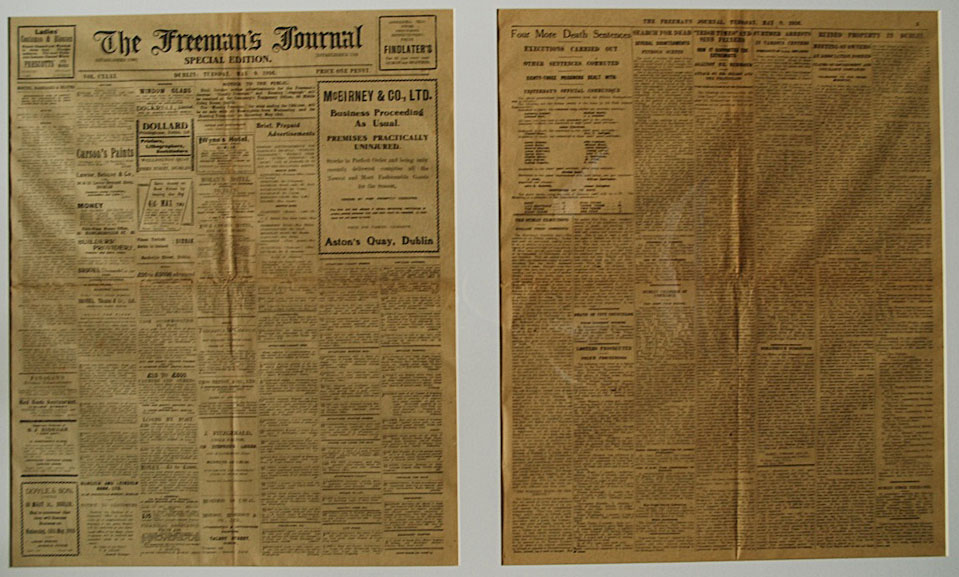
The Freeman’s Journal account of the executions of the leaders of the Easter Rising

This edition of the Freeman’s Journal lists the names of the four men executed the previous day, among them Michael Mallin who was in command of the garrison stationed in St Stephen’s Green. It also gives the reaction of the British press, with the Manchester Guardian predicting: “Further executions can only create martyrs to refresh and renew the old bitterness between England and Ireland.”

Permanent Collection

Portrait of Francis Bacon, 1976

Francis Bacon

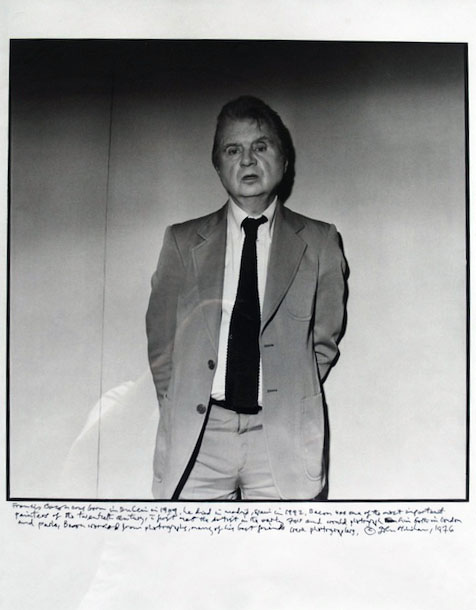
Photograph of the artist Francis Bacon

Francis Bacon was born up the road on Baggot Street. But like many other Dubliners – from Edmund Burke to Brendan Bracken – he saw himself as an Englishman. This photograph of Bacon was taken by John Minihan in 1976. Bacon’s paintings were famously bleak and emotionally raw. Margaret Thatcher once called him “that man who paints those dreadful pictures.”

Permanent Collection

Alex Findlater and Co. Tea Chest, 1940s

Findlater's sign

Findlater’s was a well-known Dublin grocer’s

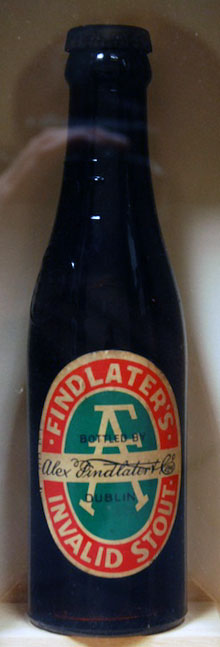
Alex Findlater and Co. started life in 1823, trading whiskey, wine and beer. The company expanded rapidly, adding general groceries to its alcohol trade, and became a major institution, with branches all over the city. Ultimately, pressure from supermarkets became too much for Findlaters’ more traditional service – as William Findlater had predicted at a 1902 staff meeting:

Findlaters stout

“This brings up the question of packet goods, which is one of the curses of the trade, unless they bear our own brand. If this is encouraged much further it will mean the passing out of the grocer, and he will be replaced by a mere hander-out of packet goods, or, we will have nothing but girls behind our counters, which may be unpleasant to many of the young men present!”

With thanks to Alex Findlater