The Theatre Royal, 1959

Theatre RoyalThe Theatre Royal is fondly remembered by many Dubliners

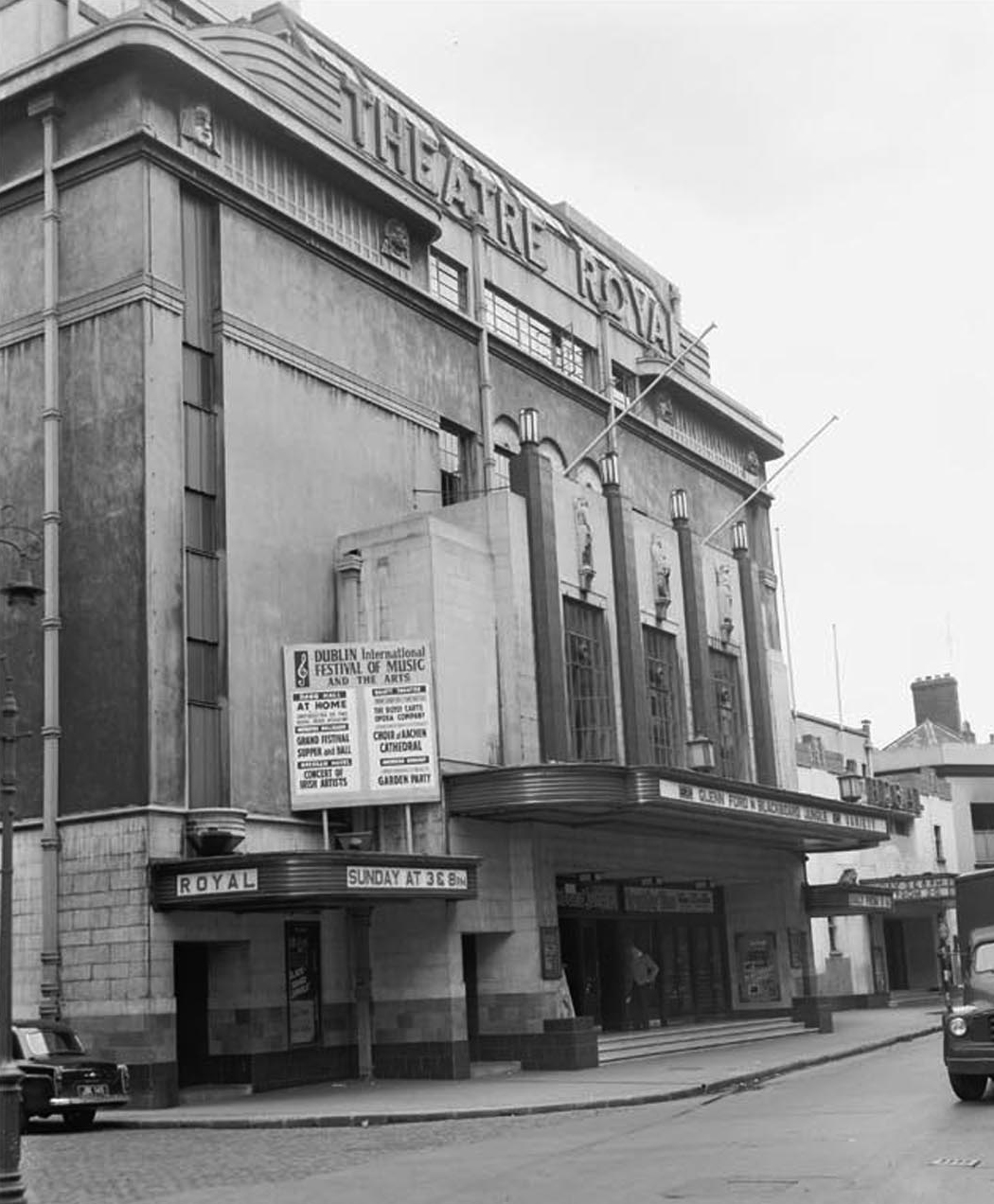
This is a photograph of the Theatre Royal, with its striking Art Deco facade and a Moorish inspired interior. It was the largest cinema in Dublin, with an auditorium that housed 3,800 people. The International Festival of Music and the Arts is being advertised, and Blackboard Jungle is showing.

The Royal had a resident 25-piece orchestra and its own dance troupe, the Royalettes. There was a Compton organ that came up out of the ground. Jimmy Campbell was the conductor. Tommy Dando and the Royalettes were a regular item; Alice del Garno and Babs de Monte; Bob Geldof’s mother worked as a cashier. Judy Garland played the Theatre Royal in 1951, wowing punters who couldn’t get tickets by singing from her dressing room window. And Danny Kaye was fondly remembered for many years by the taxi drivers of Dublin. He sang so many encores that everyone missed the last bus home.

With thanks to Fáilte Ireland
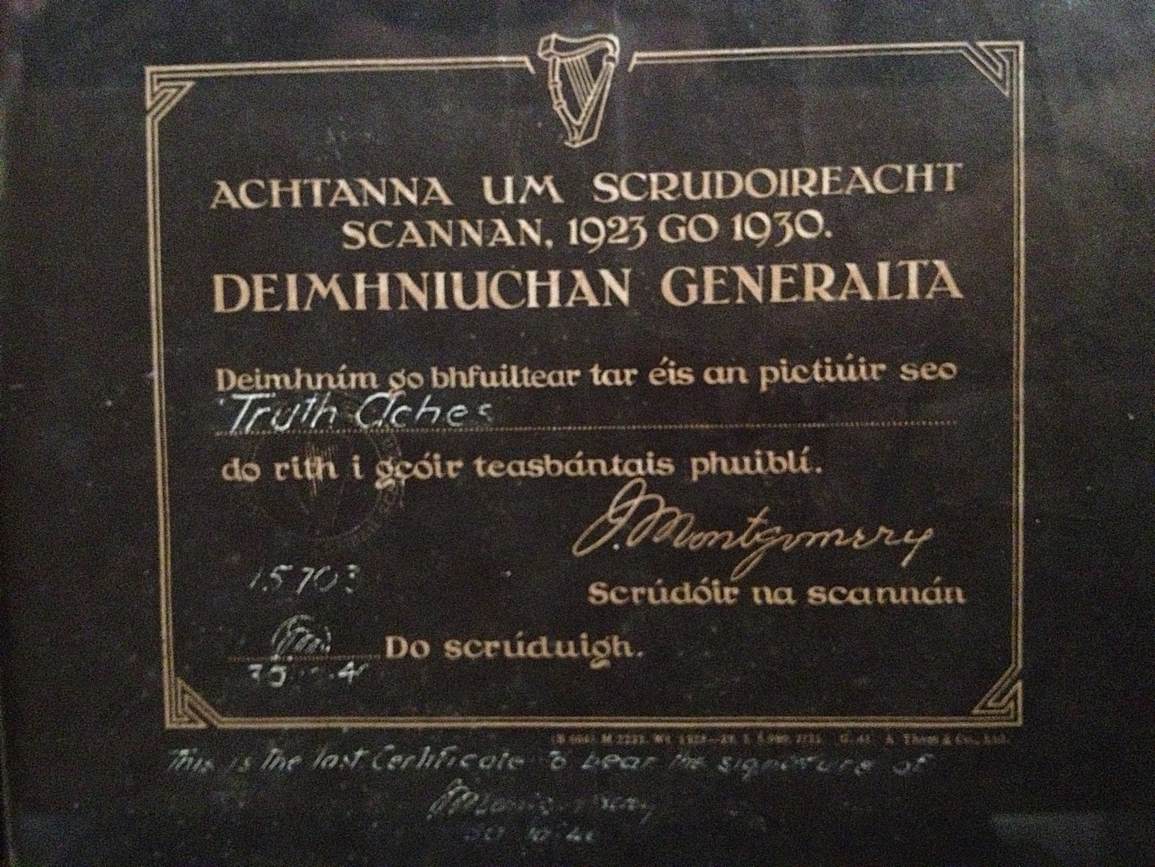
Film Censor’s Certificate, 1939

Film Censor’s Certificate, 1939

This is the last film censor’s certificate that James Montgomery ever signed

Appointed in 1923, this self-styled ‘moral sieve’ cut any scenes with kissing, blasphemy, incest, divorce, contraception, abortion, homosexuality, adultery or illegitimacy. He didn’t like the word virgin, or any mention of prostitutes – ‘with or without a heart of gold.’

Two and a half thousand films have been banned in the history of this state. Of those, James Montgomery personally banned over 1,800. He once said of a film under review: “The girl dancing on the village green shows more leg than I’ve seen on any village green in Ireland. Better amputate them.”

Watch a clip from ‘Rocky Road to Dublin’ which deals with censorship in Ireland:

The Righteous Are Bold Poster, 1954

The Righteous are Bold poster

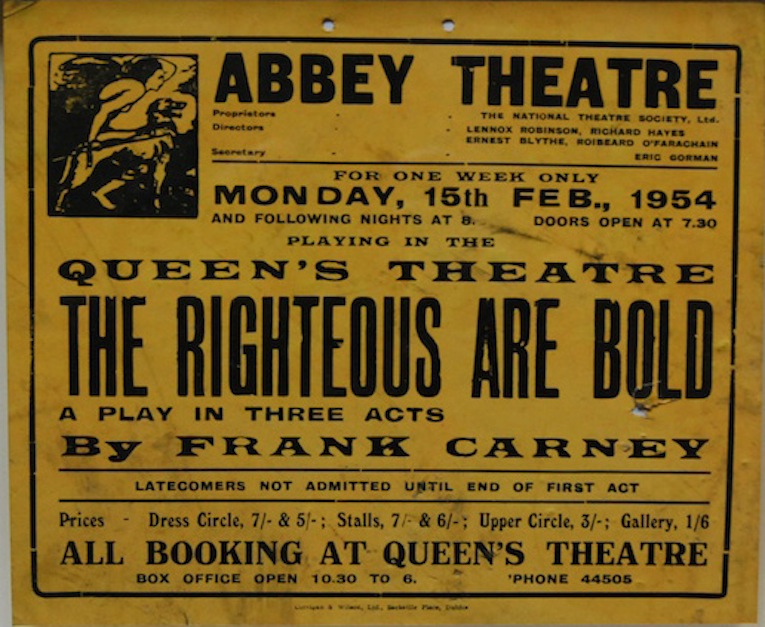
A poster for the hugely popular play “The Righteous Are Bold” at the Abbey Theatre

This poster advertises a run of The Righteous Are Bold by Frank Carney. It was the most performed play in the Abbey Theatre (which was temporarily housed in the Queen’s Theatre).

Now largely forgotten, the play was hugely popular in its day because it featured the first exorcism to be shown on an Irish stage. The plot concerns an Irish emigrant returning home from London who is possessed by some ‘evil’, and the ensuing battle between scientific, pagan and Catholic beliefs as to how it should be removed. It was performed 245 times, 96 of those on its first run in 1956.

Permanent Collection

Irish Independent, 1940

Bombs fall in Dublin and Monaghan

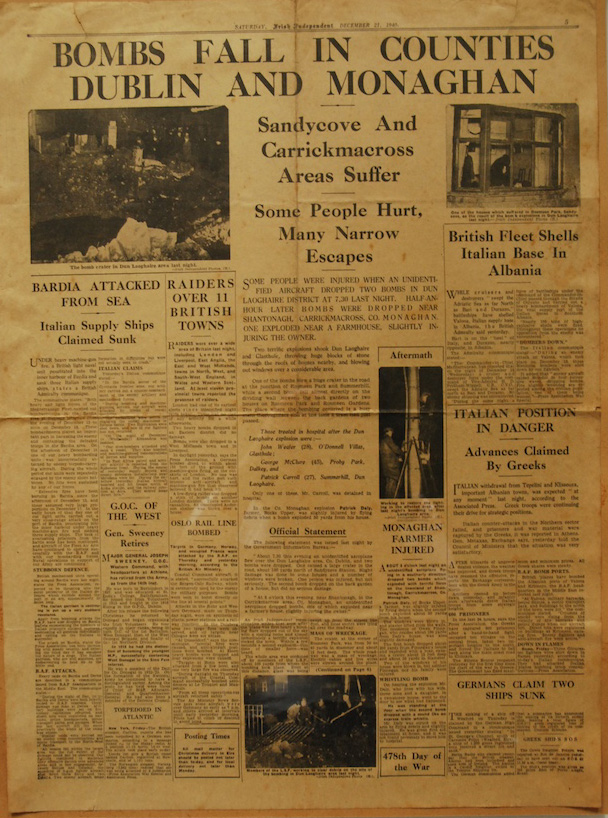
Despite Ireland’s neutrality, the country was bombed several times during the war years

Here the Irish Independent details the events of December 20th, 1940 when unidentified aircraft dropped bombs on Counties Dublin and Monaghan.

Ireland chose to remain neutral in the Second World War, but there was still a fear that the country could be attacked. A state of emergency was declared (hence ‘the Emergency’), and gas masks were made widely available. Despite Ireland’s neutrality, 28 people were killed in the 1941 North Strand bombings. In 1958, the West German government paid £327,000 in compensation to the Irish government.

Permanent Collection

Eucharistic Congress St Patrick poster, 1932

Eucharistic congress poster

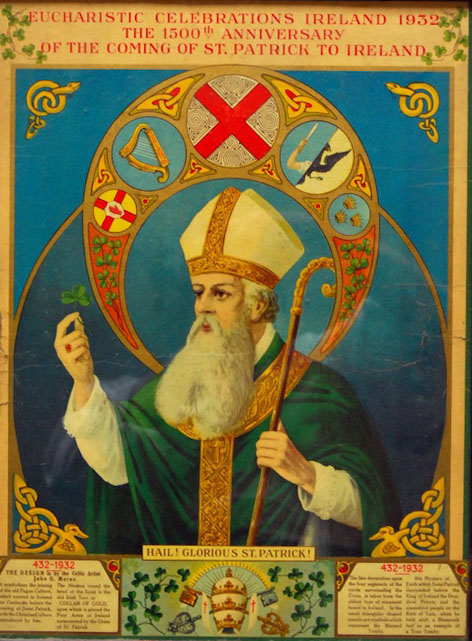
Ireland hosted the Eucharistic Congress in part to celebrate the 1,500th anniversary of the coming of St. Patrick to Ireland

One million people come to the Phoenix Park to hear mass celebrated by the Papal Legate, Cardinal Lorenzo Lauri, as part of the 31st International Eucharistic Congress.

“It would be idle to attempt to estimate the size of that awe-inspiring crowd. From the top of the colonnades the inexperienced eye was dazed by its dimensions. … It was just an infinity of men and women, marshalled into their places with consummate skill; ordered, decent and reverent, setting an example to the world of popular piety, and behaving with a quiet dignity that was worthy of the occasion which evoked it.”
The Irish Times describes the scenes at the closing mass of the 31st Eucharistic Congress in the Phoenix Park.

Permanent Collection

Letter from the Archbishop of Dublin, 1928

Archbishop letter

Letter from the Archbishop of Dublin outlining the reasons Catholics were not allowed to attend Trinity College Dublin

In his letter to Chief Justice Hugh Kennedy, Archbishop of Dublin Edward Byrne reaffirms the Catholic Church’s prohibition on Catholics entering Trinity College Dublin. The Archbishop explains: “How the authorities of any Catholic school can, in the face of their conscientious obligations, encourage their pupils to risk their soul’s salvation in Trinity College is to me an absolutely insoluble puzzle.”

To which the people of Dublin responded with a limerick:
Young men may loot, perjure and shoot,
And even have carnal knowledge,
But however depraved,
Their souls will be saved,
If they don’t go to Trinity College.

Permanent Collection

Michael Collins and Arthur Griffith, 1922

Collins

Michael Collins – portrait by John Lavery

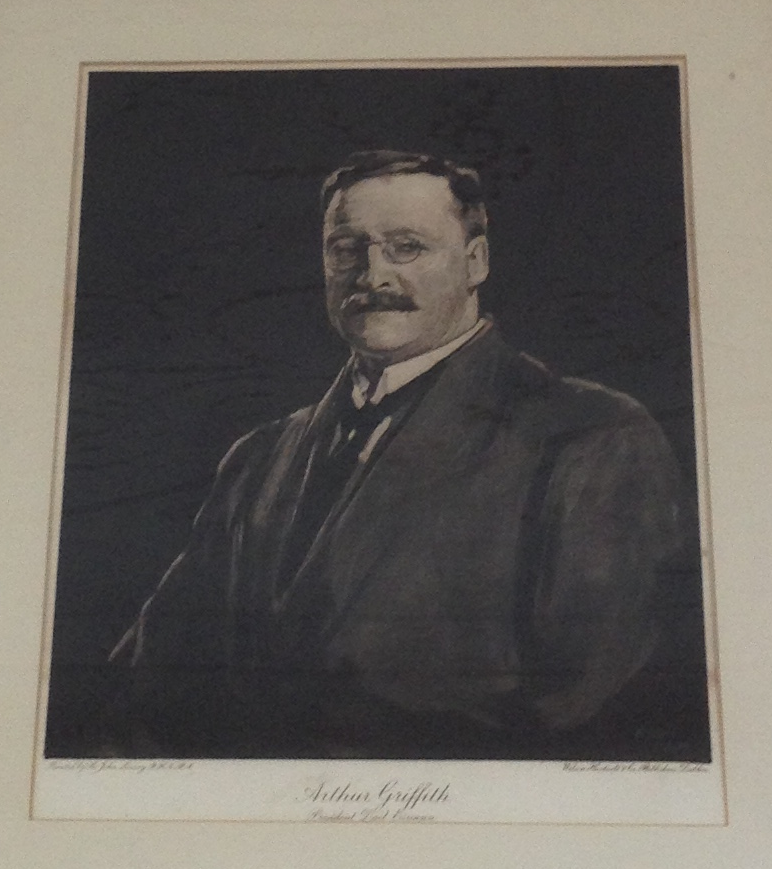
These famous portraits of Michael Collins and Arthur Griffith by Sir John Lavery were painted during the Civil War. Collins and Griffith were members of the delegation that signed the Anglo-Irish Treaty in 1921.

Arthur Griffith

The Treaty did not provide full independence from Britain, Northern Ireland would remain part of the UK and an oath to the King would have to be sworn by all members of the Dáil.

The Civil War broke out, which the anti-Treaty side eventually lost. Collins and Griffith were both dead by the end of the war – Collins killed in an ambush in Beal na mBlath, Griffith succumbing to heart failure.

With thanks to Michael Maughan

Arthur Griffith – portrait by John Lavery

Watch a video about the Anglo-Irish Peace Treaty:


Easter Rising, 1916

Pearse

Patrick Pearse, leader of the Easter Rising

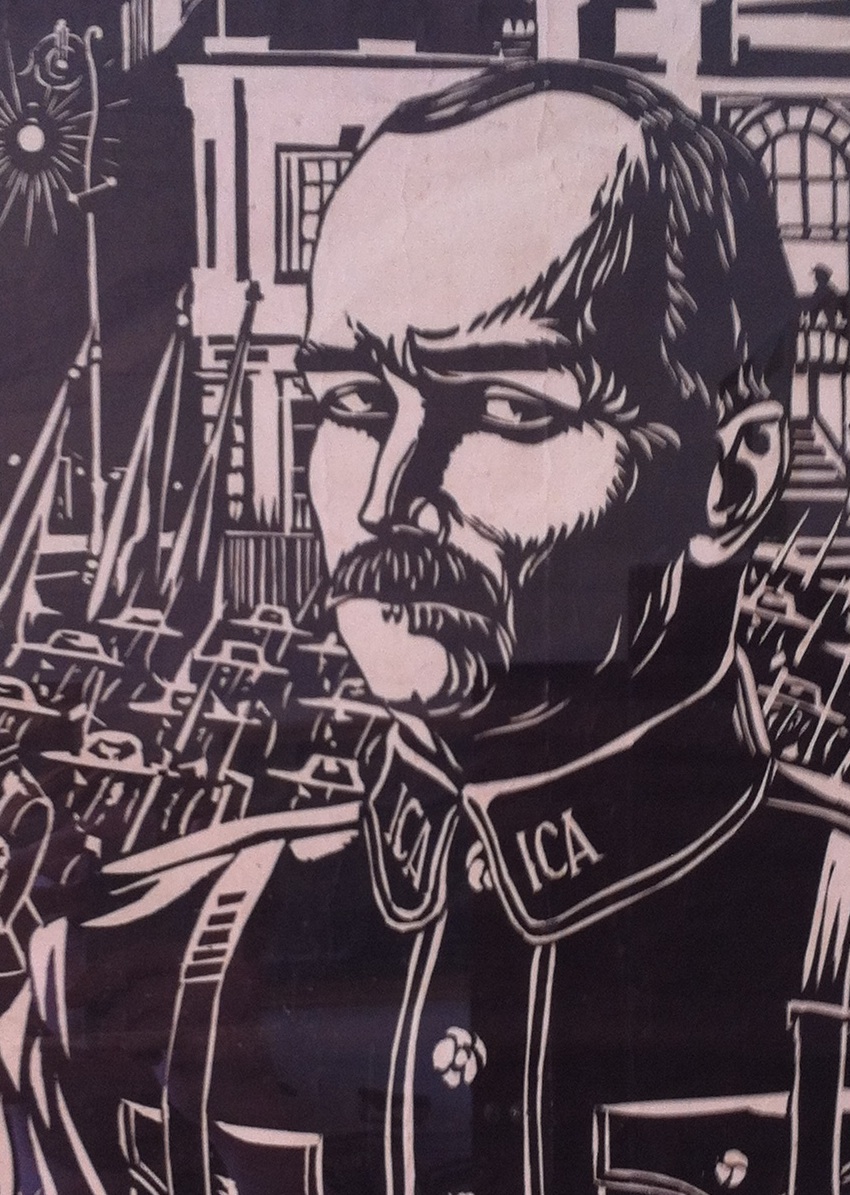
The Easter Rising of 1916 was led by Patrick Pearse (pictured above) and by James Connolly. When Pearse and Connolly were arrested after the failed rebellion, they were led away through jeering crowds. It was only after their execution that the city lurched to the defence of its martyrs.

James Connoly

James Connoly

500 people were killed in the Rising, many of them civilians caught in the crossfire, including 28 children. As Yeats put it in Easter 1916, “All changed, changed utterly: a terrible beauty is born.”

St. Stephen’s Green was the scene of fierce fighting during the Rising. The garrison led by Michael Mallin and Countess Markiewicz was stationed there, making the rebels easy targets for the British army.

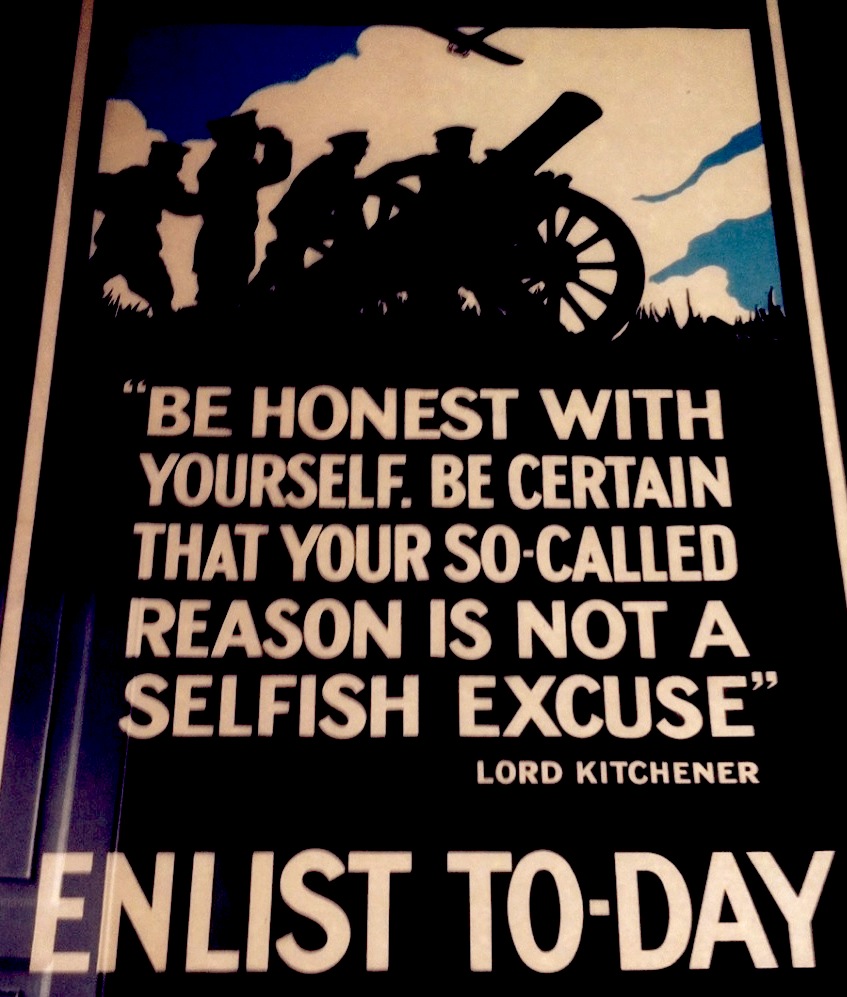
First World War Recruitment Poster, 1915

World War I

When the First World War broke out, John Redmond urged his supporters to sign up for the British Army – and many listened, if not to Redmond, then to Lord Kitchener, who was born in Kerry. Ulster Unionists saw it as an opportunity to showcase their loyalty to the Empire. The Nationalist community was divided, with Irish Parliamentary Party leader John Redmond encouraging Irishmen to join up and fight for Home Rule, while others saw “England’s difficulty as Ireland’s opportunity.” Nonetheless, over 200,000 Irishmen joined up.

The Heuston family, who lived in the house which now houses our museum, had twin sons who fought in the War. One of them was among the 30,000 Irishmen killed in the war.

Permanent Collection

Tenement life, 1900s

Tenement Life 1

Most Dubliners lived in overcrowded tenements

A hundred years ago Dublin was smaller than Belfast. Most people were poorly-housed, poorly paid or chronically unemployed, and the city had the highest infant mortality rate in Europe.

The story of tenement life is depicted in these photographs from our Darkest Dublin Collection. They were taken on what was once the grandest street in Dublin, Henrietta Street. In the census of 1911 we learn that in the 15 houses on Henrietta Street, there were 835 people. In one house alone there were over a hundred inhabitants.

Tenement Life 2

Throughout the first half of the century, nearly a third of Dublin’s population lived in overcrowded tenements. The tenement system had its origins in the middle of the 19th Century, when Dublin saw an influx of people from the countryside in the wake of the Famine. Many fine Georgian residences were converted to house far more people than they were originally designed to accommodate. In 1913 John Cooke presented his pictorial account of the city’s slums to the Dublin Housing Inquiry. The photographs now form part of the archive of the Royal Society of Antiquaries of Ireland. They represent a grim and highly vivid account of the slum conditions at that time.

With thanks to the Royal Society of Antiquaries of Ireland.

Watch an interview with Sean Garland about Tenement Dublin in the 1930s: