Invitation to a Ball in Kingstown, 1913
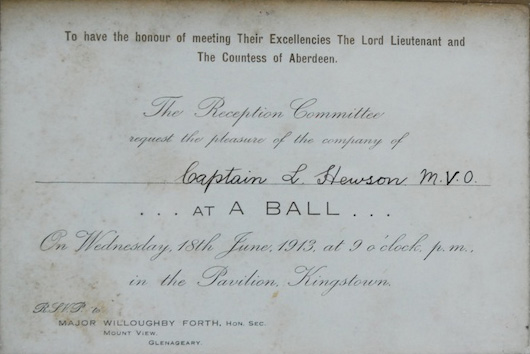
Ball invitation 1913

Ball invitation addressed to John Campbell Hamilton-Gordon

John Campbell Hamilton-Gordon, Earl of Aberdeen, served as Lord Lieutenant of Ireland briefly in 1886 before returning to the post for a nine-year spell after five years as Governor General of Canada. The Countess of Aberdeen, Isobel Hamilton-Gordon, also left her mark, serving as president of the International Council of Women as well as founding the Victorian Order of Nurses.

This invitation was sent to Captain Lionel Lloyd Hewson, a Member of the Royal Victorian Order.

Permanent Collection
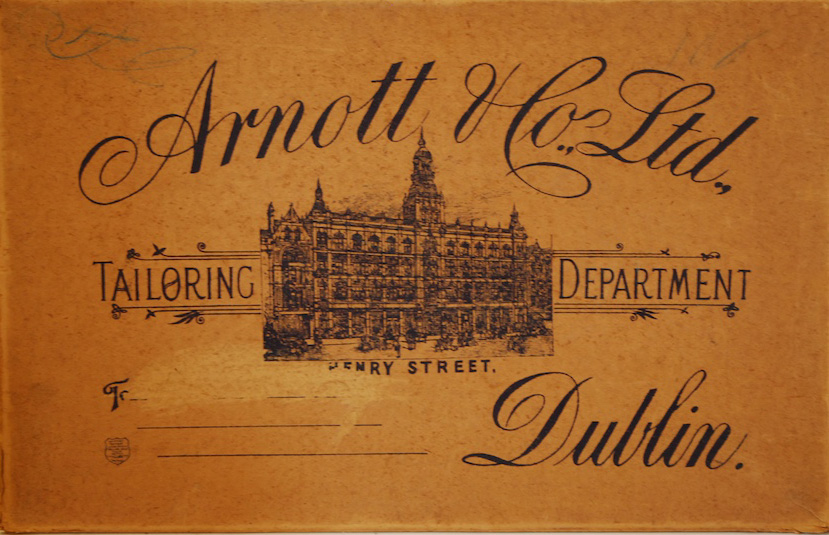
Arnotts Box, 1930s

Arnott's box

Arnotts was an iconic department store, the biggest one in Dublin

Established at 15 Henry Street in 1843, Arnotts was for many years the largest department store in Dublin. Patrick Pearse allegedly stopped off to settle his account on his way to the GPO on the day of the Rising.

Permanent Collection

Watch footage of rural Ireland in the same time period for comparison: 

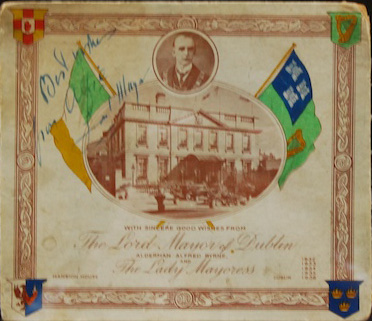
Alfie Byrne’s wishes, 1936

Alfie Byrne

Alfie Byrne was the well-loved mayor of Dublin for many years

Bicycle-wheel maker, barman, publican, councillor, senator, MP, and TD, Alderman Alfred Byrne is best remembered as Lord Mayor of Dublin. Between 1930 and 1939. Alfie, as he was affectionately known, monopolised the post of Lord Mayor, serving the city for nine consecutive terms.

A one-man political machine, he was known as The Shaking Hand of Dublin for his eternal canvassing, and he always carried a bag of sweets with him for the poor children of Dublin. Byrne returned to the Mansion House in 1954 for his tenth and final term.

Permanent Collection

Visit the British Pathe website to watch Alfie Byrne delivering a speech:

http://www.britishpathe.com/video/interview-with-mr-alfred-byrne-lord-mayor-of-dubli

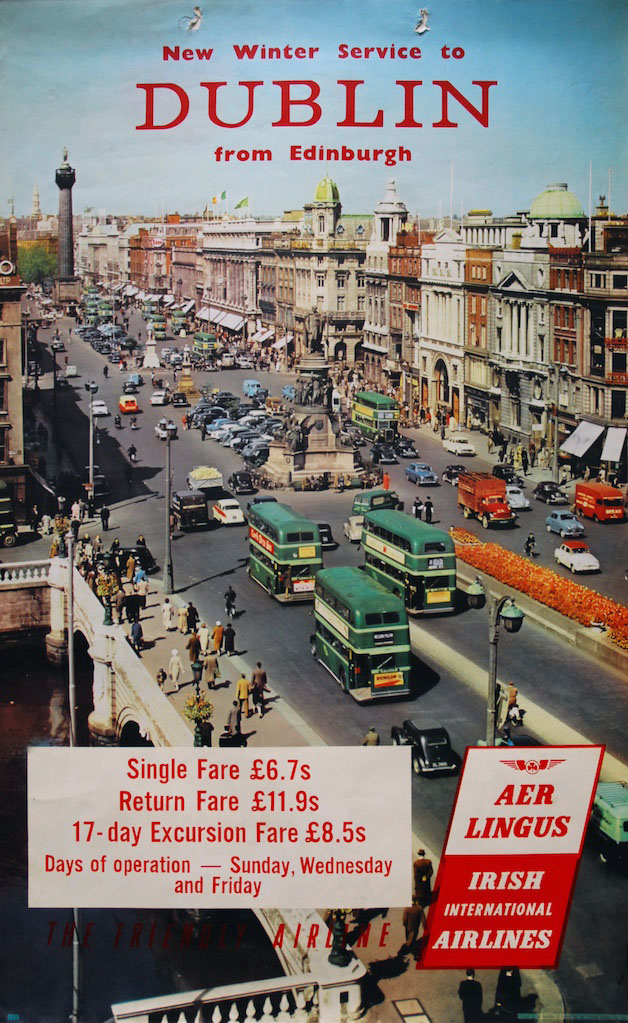
Aer Lingus Edinburgh to Dublin Ad, 1960s

Aer Lingus winter service

Air travel only became widespread in the second half of the twentieth century

Strange as it now seems, air travel was once perceived as a glamorous activity. This elegant poster advertises the Aer Lingus service between Edinburgh and Dublin.

With thanks to Aer Lingus

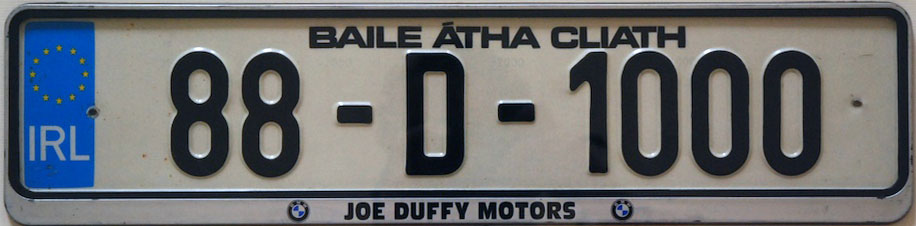
Millennium Car, 1988

1988 numberplate

This is the number plate from the Lord Mayor Carmencita Hederman’s car in 1988

The Lord Mayor’s car registration is normally D-1, but was changed to D-1000 specially for the Millenium year.

With thanks to Carmencita Hederman

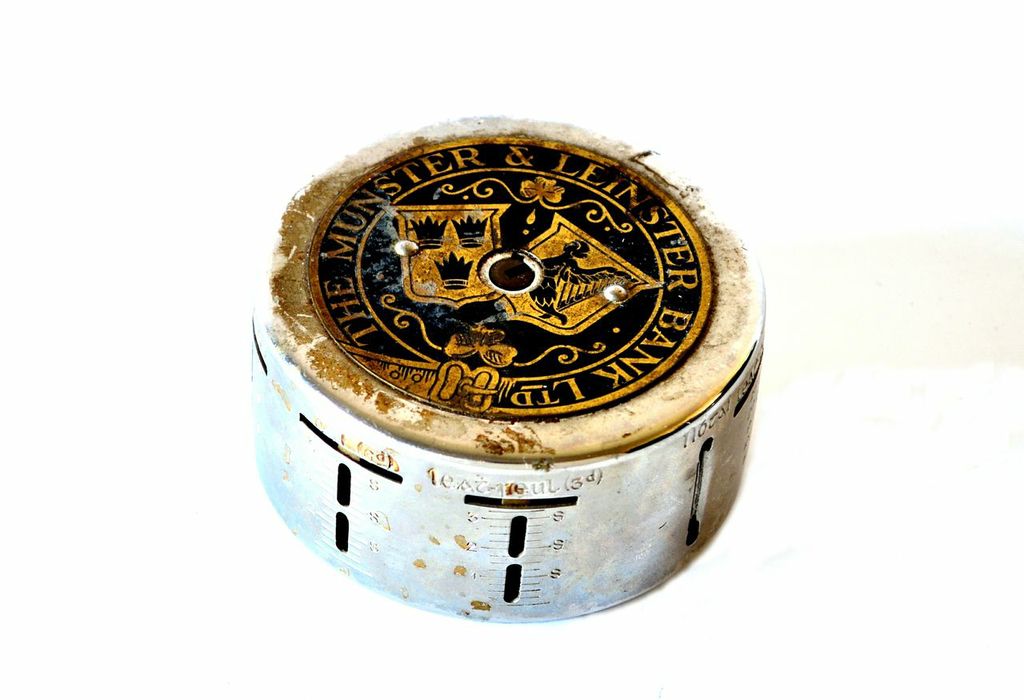
Money Counter, 1960s

Money Counter, 1960s

This money counter was for use with pre-decimalisation coins

The Munster and Leinster Bank was founded in 1864, in 1867 purchased some of the branches of the unsuccessful Union Bank of Ireland, in 1870 acquired the long established private bank David La Touche & Son and in 1885 failed due to mismanagement and fraud and is liquidated. However, Munster and Leinster Bank commences operations.

In 1966, Allied Irish Banks Limited was established, a new company that acquired three Irish banks: Provincial Bank of Ireland, the Royal Bank of Ireland, and the Munster & Leinster Bank. The banks saw an alliance as the best way to overcome the fragmented nature of the Irish banking industry.

With thanks to Olive Murray

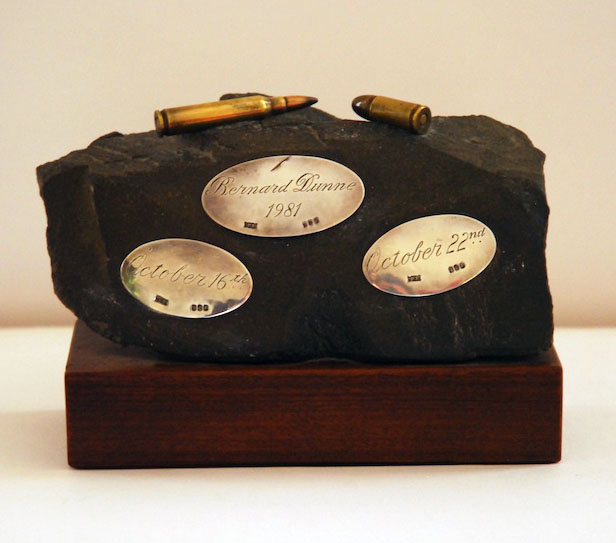
Bullets from Ben Dunne’s Kidnappers, 1981

Ben Dunne bullets

The bullets given to Ben Dunne before his release by the IRA 

On the 16th of October, 1981, Ben Dunne Jnr. was kidnapped by the IRA on his way to open a new Dunnes Store in Portadown. Before his release on the 22nd of October, two of his abductors gave him some bullets and told him that they could easily have been used – one on him and the other on Fr. Dermot McCarthy.

Fr. McCarthy had tried to secure Dunne’s release, making a plea on television and at one point meeting with Dunne’s kidnappers. McCarthy was nearly shot in crossfire. After his release, Ben Dunne mounted the bullets on a piece of stone from the cemetery in Armagh where he had been held captive.

With thanks to Mark Dunne

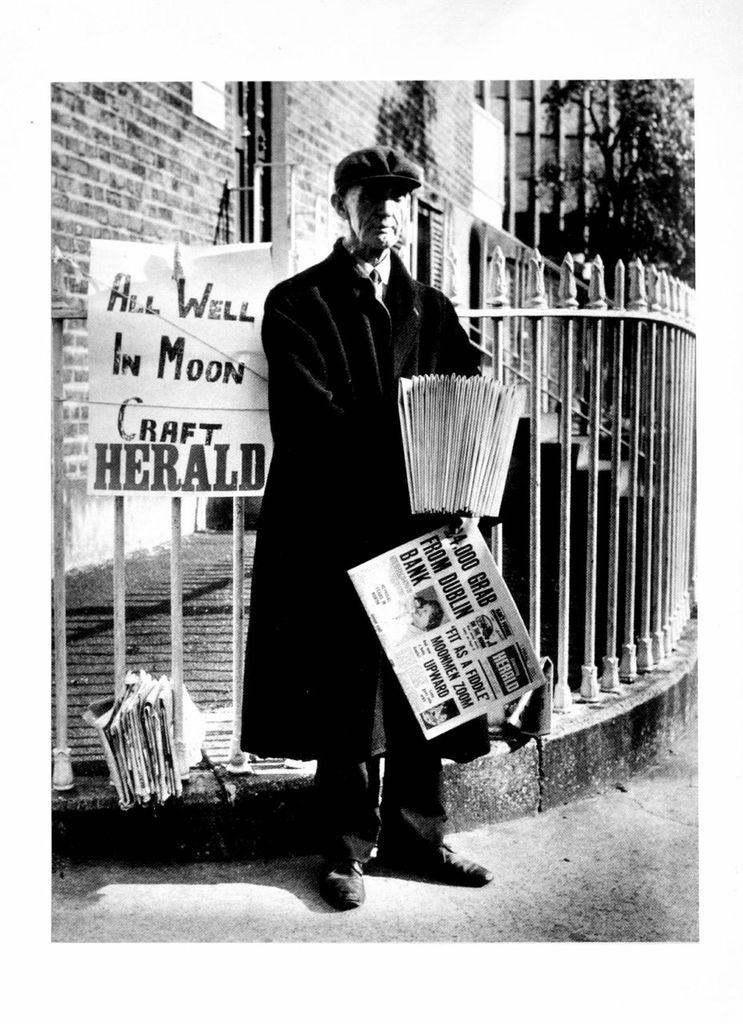
Leeson Street by Bill Doyle, 1969

Leeson Street by Bill Doyle, 1969

Selling newspapers on street corners was common in Dublin

In Bill Doyle’s iconic photo the headline ‘All well in Moon Craft’ refers to the Apollo 11 mission. For many years street vendors sold the Evening Herald and the Evening Press, which led to the catch-all cry “Heralorpress!”

The two papers enjoyed a healthy rivalry for many years, but the market is on the wane nowadays and only the Herald survives. It is still sold on the streets, but modern hawkers are rather less vocal.

With thanks to Leslie Doyle for Bill Doyle and Lilliput Press

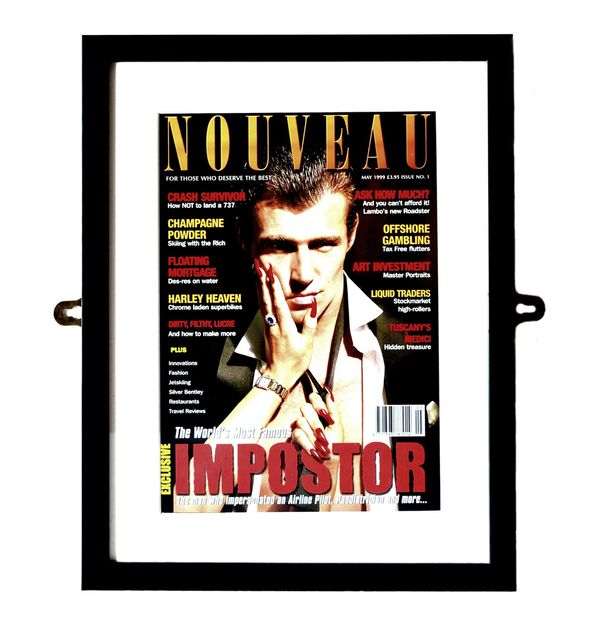
Nouveau, First Issue, 1999

Nouveau First Issue

This periodical is evidence for the case that some people lost the run of themselves

Only in Ireland in the year 1999 could a magazine aimed at the new rich be called Nouveau without a shred of irony.

Ken Bryan, the magazine’s publisher, writes in his first editorial: “By all accounts, the risks [of publishing] are minimal.” There is no issue two of Nouveau magazine.

Permanent Collection

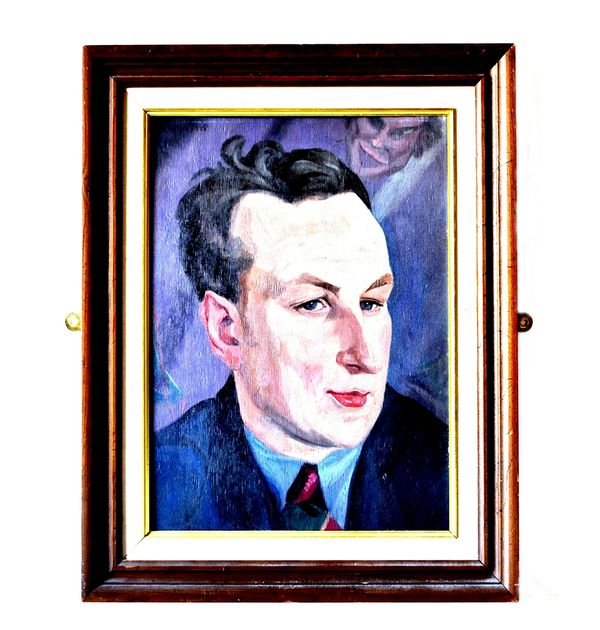
Hilton Edwards by Harry Kernoff, 1928

Hilton Edwards by Harry Kernoff

Hilton Edwards, co-founder of the Gate theatre

Contrary to appearances, the Irish are not visually illiterate. This fine portrait of Hilton Edwards is by the Jewish artist Harry Kernoff.

In 1928 Edwards co- founded the Gate Theatre with Micheál MacLiammóir, who like Edwards was actually English. In the Gate they presented European plays in contrast to the Irish peasant fare at the Abbey. (The two theatres were written off as Sodom and Begorrah.) Edwards sat for this portrait in 1928, the year the Gate was founded.

With thanks to Don Buckley

Watch some clips of Micheál MacLiammóir acting: